

What Did Russia, France, Serbia, United States And Great Britain Makeup During Ww1
Russian federation entered World War I in the three days succeeding July 28, 1914 — showtime with Republic of austria-Hungary'southward declaration of war against Serbia, a Russian ally. Via St Petersburg, the Russian Empire sent an ultimatum to Vienna, warning Austro-hungarian empire not to attack Serbia. Following the invasion of Serbia, Russian federation began to mobilize its very large reserve ground forces. Consequently, on July 31, the German Empire in Berlin demanded Russian demobilization. There was no response; hence, on the aforementioned twenty-four hour period, Federal republic of germany alleged war on Russian federation. In accord with its war plan, Deutschland ignored Russian federation and moved offset against France past declaring state of war on Baronial iii, and by sending its main armies through Kingdom of belgium to surround Paris. The threat to Belgium caused Britain to declare state of war on Deutschland on August 4. Germany alleged state of war on Russia on August 1, 1914.[ citation needed ] The chief belligerents had been established. The Ottoman Empire soon joined the Central Powers and fought Russia forth their border.
Historians researching the causes of Globe State of war I accept emphasized the function of Federal republic of germany and Austro-hungarian empire. Scholarly consensus has typically minimized Russian interest in the outbreak of this mass disharmonize. Key elements were Russia'southward defence of Orthodox Serbia, its pan-Slavic roles, its treaty obligations with French republic, and its business with protecting its status as a great power. However, historian Sean McMeekin has emphasized Russian plans to expand its empire southward and to seize Constantinople equally an outlet to the Mediterranean Sea.[1]
Archduke Franz Ferdinand, heir to the Austro-Hungarian throne, was assassinated by Bosnian Serbs on 28 June 1914 due to Republic of austria-Hungary's annexation of the largely Slavic province. Vienna was unable to observe prove that the Serbian state had sponsored this assassination but, 1 calendar month after, it issued an ultimatum to Serbia, which information technology knew would be rejected and thus atomic number 82 to war. Austro-hungarian empire accounted Serbia to be deserving of penalisation for the assassination. Although Russia had no formal treaty obligation to Serbia, information technology wanted to control the Balkans, and had a long-term perspective toward gaining a military advantage over Germany and Austria-Republic of hungary. Russia had incentive to delay militarization, and the majority of its leaders wanted to avert war. Notwithstanding, Russia had the back up of France and feared that a failure to defend Serbia would atomic number 82 to the loss of Russian brownie, constituting a major political defeat in its goal of controlling the Balkans.[ii] Tsar Nicholas Two mobilized Russian forces on 30 July 1914 to threaten Austro-hungarian empire if it invaded Serbia. Christopher Clark stated: "The Russian general mobilization [of xxx July] was 1 of the most momentous decisions of the August crisis". The first general mobilization occurred before the German regime had alleged a state of impending war.[3]
Germany felt threatened by Russian federation, responding with its own mobilization and a declaration of war on 1 Baronial 1914. At the outset of hostilities, Russian forces led offensives against both Germany and Austria-hungary.[iv]
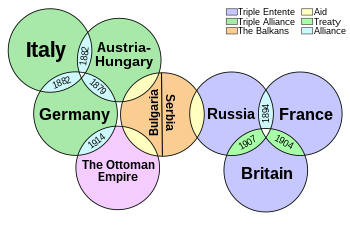
European diplomatic alignments before long before the war.
Groundwork [edit]
Betwixt 1873 and 1887, Russian federation was allied with Germany and Austro-hungarian empire in the League of the Three Emperors and and then with Germany in the 1887-1890 Reinsurance Treaty. Both collapsed because of the competing interests of Austria-Hungary and Russia in the Balkans. France took advantage of that to agree the 1894 Franco-Russian Alliance, but Britain viewed Russia with deep suspicion considering of The Groovy Game. In 1800, over 3,000 km separated Russia and British India, simply by 1902, it was thirty km in some areas with Russian advances into Primal Asia.[five] That threatened to bring the two into direct disharmonize, as did the long-held Russian objective of gaining control of the Bosporus Straits and with it access to the British-dominated Mediterranean Sea.[half-dozen]

Russian recruiting poster; caption reads 'World on fire; Second Patriotic War. 1900s'
Defeat in the 1905 Russo-Japanese State of war and Britain's isolation during the 1899-1902 Second Boer War led both parties to seek allies. The Anglo-Russian Convention of 1907 settled disputes in Asia and immune the establishment of the Triple Entente with France, which was still largely informal. In 1908, Austro-hungarian empire annexed the former Ottoman province of Bosnia and herzegovina, and Russia responded by creating the Balkan League to prevent further Austrian expansion.[vii]
In the 1912-1913 First Balkan War, Serbia, Bulgaria and Greece captured nearly of the remaining Ottoman possessions in Europe. Disputes over their division resulted in the Second Balkan State of war in which Bulgaria was comprehensively defeated by its former allies.
Russia'due south industrial base of operations and railway network had significantly improved since 1905 although from a relatively-low base. In 1913, Nicholas II canonical an increase in the Russian Army of over 500,000 men. Although there was no formal alliance betwixt Russia and Serbia, their shut bilateral links provided Russia with a route into the crumbling Ottoman Empire, where Deutschland as well had significant interests. Combined with the increase in Russian military strength, both Austria and Germany felt threatened by Serbian expansion. When Austria invaded Serbia on 28 July 1914, Russian Foreign Minister Sergei Sazonov viewed information technology every bit an Austro-German language conspiracy to end Russian influence in the Balkans.[eight]
On 30 July, Russian federation alleged full general mobilization in support of Serbia. On i August, Deutschland declared state of war on Russian federation, followed by Austria-Hungary on the 6th. Russia and the Entente declared war on the Ottoman Empire in November 1914, subsequently Ottoman warships had bombarded the Black Ocean port of Odessa in late Oct.[9] Unlike its Allies, the Russian Empire was one face-to-face landmass, only it also considered itself the defender of its fellow Slavs in places like Serbia.
Major players [edit]
Historians agree on the poor quality of Russia's top leadership.[10] Tsar Nicholas II made all terminal decisions only was repeatedly given conflicting advice and typically made the incorrect choice. He set up a securely flawed organizational structure that was inadequate for the loftier pressures and the instant demands of wartime. The British historian David Stevenson, for example, points to the "disastrous consequences of deficient civil-military liaison" in which the civilians and generals were not in contact with each other. The government was entirely unaware of its fatal weaknesses and remained out of touch with public stance. The strange minister had to warn Nicholas that "unless he yielded to the popular demand and unsheathed the sword on Serbia's behalf, he would run the risk of revolution and the loss of his throne". Nicholas yielded but lost his throne anyway. Stevenson concludes:
- Russian controlling in July [1914] was more truly a tragedy of miscalculation... a policy of deterrence that failed to deter. Yet [similar Germany] information technology also rested on assumptions that war was possible without domestic breakup, and that it could be waged with a reasonable prospect of success. Russian federation was more vulnerable to social upheaval than any other Ability. Its socialists were more estranged from the existing lodge than those elsewhere in Europe, and a strike moving ridge among the industrial workforce reached a crescendo with the full general stoppage in St. Petersburg in July 1914.[11]
Foreign Minister Sergei Sazonov was not a powerful thespian. According to the historian Thomas Otte, "Sazonov felt too insecure to advance his positions against stronger men.... He tended to yield rather than to press home his own views.... At the critical stages of the July crisis Sazonov was inconsistent and showed an uncertain grasp of international realities.[12] The Tsar fired Sazonov in July 1916 and gave his ministry as an extra portfolio to Prime number Minister Stürmer. The French ambassador was aghast, depicting Stürmer as "worse than a mediocrity – a third rate intellect, hateful spirit, depression character, doubtful honesty, no experience, and no idea of state business concern."[13]
French Ambassador Maurice Paléologue was also influential by repeatedly promising France would go to state of war along with Russian federation, which was indeed the position of President Raymond Poincaré.
- Nicholas II — Russian Emperor, until xv March 1917)
- Grand Duke Nicholas Nikolaevich – Commander-in-main (1 August 1914 – v September 1916) and viceroy in the Caucasus
- Ivan Goremykin – Chairmen of Council of Ministers of the Russian Empire (i August 1914 – 2 Feb 1916)
- General of the Artillery Nikolay Ivanov – Commander of the Russian ground forces on the Southwestern Front, (i Baronial 1914 – March 1916) responsible for much of the action in Galicia
Serious planning for a hereafter war was practically impossible because of the complex rivalries and priorities given to royalty. The primary criteria for high command was linkage to the royalty, rather than expertise. The Full general Staff had expertise but was ofttimes outweighed past the aristocracy Regal Guards, a favorite bastion of the aristocracy that prized parades over planning big-calibration armed services maneuvers. The yard dukes inevitably gained high commands. At 1 disquisitional point in 1915, when One thousand Duke Nicholas failed badly, the tsar himself took over directly command and command of the entire Army, despite his incompetence. Meanwhile, the tsar allowed the conniving monk Grigori Rasputin to exert enormous influence through his wife, including high-level appointments. The aristocrats finally assassinated him a few weeks before the tsar himself was overthrown. The infantry, artillery, cavalry and logistics services suffered poor communications with one another. The army was fabricated up of peasants, who were ready plenty to defend their own villages merely showed little national pride. Recruits from Russia's numerous minorities were often persecuted in the barracks.[fourteen]
French brotherhood [edit]
Russian federation depended heavily on the French alliance since a two-front war against Germany was winnable but not if Russia was alone. The French administrator, Maurice Paléologue, hated Germany and saw that when war broke out, French republic and Russia had to be close allies against Germany. His approach agreed with French President Raymond Poincaré, who trusted him. Unconditional French support to Russian federation was promised in the unfolding crunch with Germany and Austria. Historians debate whether Palégogue exceeded his instructions but agree that he failed to inform Paris of exactly what was happening, and he did not warn that Russian mobilization might launch a world war.[15] [16] [17]
Beginning of war [edit]
On 28 June 1914, Archduke Franz Ferdinand of Austria was assassinated in Sarajevo, and Tsar Nicholas II vacillated equally to Russian federation's grade of activeness. A relatively-new cistron influencing Russian policy was the growth of Pan-Slavism, which identified Russia's duty to all Slavs, especially those who skillful Eastern Orthodox Christianity. The growth of that impulse shifted attending away from the Ottoman Empire and toward the threat posed to the Slavic people by the Austria-hungary. Serbia identified itself equally the champion of the Pan-Slavic ideal, and Austria-hungary planned to destroy Serbia for that reason.[18] Nicholas wanted to defend Serbia but not to fight a state of war with Frg. In a serial of letters exchanged with Kaiser Wilhelm of Frg (the and so-chosen "Willy and Nicky correspondence"), both cousins proclaimed their desire for peace, and each attempted to go the other to back down. Nicholas desired Russia's mobilization to be only confronting Austro-hungarian empire in the hopes of avoiding state of war with Germany. The Kaiser, however, had pledged to back up Austria-hungary.
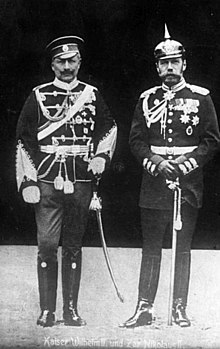
Nicky (Tsar Nicholas Ii) (right) with Willy (Kaiser Wilhelm) in 1905. Nicholas is wearing a High german Regular army uniform, and Wilhelm is wearing that of a Russian hussar regiment.
On 25 July 1914, Nicholas decided to intervene in the Austro-Serbian conflict, a step toward general state of war. He put the Russian army on "alert" on 25 July. Although information technology was non general mobilization, the German and Austro-Hungarian borders were threatened and looked similar military training for war. Nevertheless, the Russian Army had few workable plans and no contingency plans for a partial mobilization. On xxx July 1914, Nicholas took the fateful step of confirming the society for general mobilization, despite existence very reluctant.
On 28 July, Austria-Hungary formally alleged war against Serbia.[19] [20] Count Witte told the French Administrator, Maurice Paléologue that the Russian point of view considered the war to be madness, Slavic solidarity to exist simply nonsense and cypher could be hoped by war.[21]
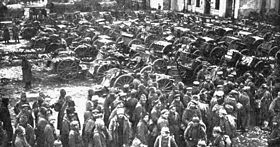
Russian prisoners at the Battle of Tannenberg, where the Russian 2nd Army was annihilated by German forces
On xxx July, Russia ordered general mobilization but even so maintained that it would not attack if peace talks began. Germany, reacting to the discovery of Russian partial mobilization ordered on 25 July, announced its own pre-mobilization posture, the imminent danger of war. Germany told Russia to demobilize within twelve hours. In Leningrad at 7 p.m., the German ultimatum to Russia expired. The German ambassador to Russian federation met Russian Foreign Minister Sergei Sazonov; asked 3 times if Russia would reconsider; and, with shaking hands, delivered the note accepting Russia's war challenge and declaring state of war on 1 August. On 6 August, Franz Joseph I of Republic of austria signed the Austro-Hungarian declaration of war against Russia.
At the outbreak of war, each of the European powers began to publish selected, and sometimes misleading, compendia of diplomatic correspondence, seeking to institute justification for their own entry into the war, and to cast arraign on other actors.[22] The get-go of these color books to appear was the German White Volume[23] which appeared on 4 August 1914, the same 24-hour interval as U.k.'s war declaration.[24] The British Blue Book came out 2 days later,[25] followed by the Russian Orange Book in mid-August.[24]
War machine weakness [edit]
The outbreak of war on ane August 1914 plant Russia grossly unprepared.[26] The Allies placed their faith in the Russian army, the famous 'Russian steamroller'. Its pre-war regular strength was 1,400,000, mobilization added 3,100,000 reserves and millions more stood set up backside them. In every other aspect, however, Russia was unprepared for state of war. Frg had ten times equally much railway runway per square kilometer, and Russian soldiers traveled an average of ane,290 kilometres (800 mi) to accomplish the front, simply German soldiers traveled less than a quarter of that altitude. Russian heavy industry was notwithstanding too pocket-sized to equip the massive armies that the Tsar could raise, and its reserves of munitions were pitifully pocket-size. While the German language ground forces in 1914 was better equipped than any other homo for man, the Russian army was severely short on artillery pieces, shells, motorized transports, and even boots.[27]
Before the war, Russian planners had completely neglected the critical logistical outcome of how the Allies could ship supplies and munitions to Russia. With the Baltic Sea barred by German U-boats and surface ships and the Dardanelles by the guns of Germany'due south ally, the Ottoman Empire, Russia initially could receive assist simply via Archangel, which was frozen solid in winter, or via Vladivostok, which was over six,400 kilometres (iv,000 mi) from the forepart line. By 1915, a new rail line was begun which gave access to the water ice-gratis port of Murmansk by 1917.[28]

The Russian High Command was profoundly weakened past the mutual contempt between War Minister Vladimir Sukhomlinov and the experienced warrior Yard Knuckles Nicholas, who commanded the armies in the field. However, an immediate attack was ordered confronting the High german province of East Prussia. The Germans mobilized in that location with groovy efficiency and completely defeated the ii Russian armies that had invaded. The Boxing of Tannenberg, where the unabridged Russian Second Regular army was annihilated, cast an ominous shadow over the empire's future. The loyal officers lost were the very ones that were needed to protect the dynasty. The Russian armies had some success against both the Austro-Hungarian and the Ottoman Armies, simply they were steadily pushed back by the German language Regular army. In September 1914, to relieve pressure level on France, the Russians were forced to halt a successful offensive against Austria-Republic of hungary in Galicia to attack German-held Silesia.[29] The primary Russian goal was focused on the Balkans and particularly taking control of Constantinople. The Ottoman entry into the war opened up new opportunities, but Russian federation was much also hard-pressed to take advantage of them. Instead, the authorities incited Britain and France into to the activity at Gallipoli, which failed very badly. Russia then incited a rebellion by the Armenians, who were massacred in 1 of the great atrocities of the war, the Armenian genocide. The combination of poor grooming and poor planning destroyed the morale of Russian troops and gear up the phase for the collapse of the unabridged regime in early 1917.[30]

Gradually, a war of compunction gear up in on the vast Eastern Front; the Russians were facing the combined forces of Germany and Austria-Republic of hungary and suffered staggering losses. General Anton Denikin, retreating from Galicia wrote:
- The High german heavy artillery swept away whole lines of trenches, and their defenders with them. Nosotros hardly replied. There was naught with which nosotros could answer. Our regiments, although completely exhausted, were beating off one attack afterward another by bayonet... Blood flowed unendingly, the ranks became thinner and thinner and thinner. The number of graves multiplied.[31]
Legacy [edit]
Historians on the origin of the Offset World War have emphasized the role of Germany and Austria-Hungary. The consensus of scholars includes scant mention of Russia and only brief mentions of Russian federation'due south defense of Orthodox Serbia, its pan-Slavic roles, its treaty obligations with France, and its concern for protecting its status equally a cracking power.[i]
However, the historian Sean McMeekin has emphasized Russian federation's aggressive expansionary goal to the s. He argues that for Russia the war was ultimately about the Ottoman Empire and that the Strange Ministry building and Army were planning a war of assailment from at least 1908 and perhaps even 1895. He emphasizes that the firsthand goal was to seize Constantinople and an outlet to the Mediterranean by command of the Straits.[32] Reviewers have more often than not been negative on McMeekin's revisionist interpretation.[33] [34]
See too [edit]
- Strange policy of the Russian Empire
- Allies of Earth State of war I
- Triple Entente
- Causes of World War I
- July Crisis
- Diplomatic history of World War I
- Austro-Hungarian entry into World War I
- British entry into Earth War I
- French entry into World War I
- High german entry into World War I
- Historiography of the causes of Globe War I
- Ottoman entry into World War I
- International relations of the Great Powers (1814–1919)
References [edit]
- ^ a b Sean McMeekin (2011). The Russian Origins of the First Globe State of war. Harvard Up. pp. 2–v. ISBN9780674063204.
- ^ Jack S. Levy, and William Mulligan, "Shifting power, preventive logic, and the response of the target: Germany, Russia, and the Start World War." Journal of Strategic Studies 40.five (2017): 731-769.
- ^ Christopher Clark, The Sleepwalkers: How Europe Went to War in 1914 (2013 p 509.
- ^ West. Bruce Lincoln, Passage Through Armageddon: The Russians in War and Revolution, 1914–1918 (1986)
- ^ Hopkirk, Peter (1990). The Groovy Game; On Secret Service in High Asia (1991 ed.). OUP. pp. four–five. ISBN978-0719564475.
- ^ Dennis, Alfred L.P. (December 1922). "The Freedom of the Straits". The North American Review. 216 (805): 728–729. JSTOR 25112888.
- ^ Stowell, Ellery Cory (1915). The Diplomacy of the State of war of 1914: The Beginnings of the War (2010 ed.). Kessinger Publishing. p. 94. ISBN978-1165819560.
- ^ Jelavich, Barbara (2008). Russia's Balkan Entanglements. Cambridge University Press. p. 262. ISBN978-0521522502.
- ^ Afflerbach, Holger (ed), Stevenson, david (ed), Aksakal, Mustafa (2012). State of war every bit a Saviour? Hopes for War & Peace in Ottoman Politics before 1914 in An Improbable War? the Outbreak of World War I and European Political Culture Earlier 1914. Berghahn Books. p. 293. ISBN978-0857453105. CS1 maint: multiple names: authors list (link)
- ^ D.C.B. Lieven, Russia and the Origins of the Outset World State of war (1983) pp 51-140
- ^ David Stevenson, The First Earth State of war and International Politics (1988) pp. 31–32.
- ^ T. G. Otte (2014). July Crisis: The World'southward Descent into War, Summer 1914. pp. 123–24.
- ^ Walter K. Moss, A History of Russia: volume I: to 1917 (1997) pp. 499–504, quote on p. 503
- ^ Peter Gatrell, "Tsarist Russia at War: The View from In a higher place, 1914–February 1917." Periodical of Modern History 87.three (2015): 668-700 at pp 674-77.
- ^ Richard F. Hamilton and Holger H. Herwig. Decisions for state of war, 1914-1917 (2004) pp 121-22.
- ^ Christopher Clark, The sleepwalkers: How Europe went to state of war in 1914 (2012) pp 435-l, 480-84.
- ^ Sidney B. Fay, The Origins of the World War (1934) ii:443-46.
- ^ Katrin Boeckh, "The Rebirth of Pan-Slavism in the Russian Empire, 1912–thirteen." in Katrin Boeckh and Sabine Rutar, eds. The Balkan Wars from Contemporary Perception to Historic Memory (2016) pp. 105-137.
- ^ Hew Strachan, The First World War, Vol I: To Arms (2001), p. 85
- ^ Richard F. Hamilton, and Holger H. Herwig, eds.) Origins of Globe War One (2003) p. 514
- ^ Robert K. Massie (1967). Nicholas and Alexandra: The Fall of the Romanov Dynasty. p. 299. ISBN9780679645610.
- ^ Hartwig, Matthias (12 May 2014). "Colour books". In Bernhardt, Rudolf; Bindschedler, Rudolf; Max Planck Institute for Comparative Public Law and International Police force (eds.). Encyclopedia of Public International Constabulary. Vol. 9 International Relations and Legal Cooperation in General Diplomacy and Consular Relations. Amsterdam: North-Kingdom of the netherlands. p. 24. ISBN978-1-4832-5699-3. OCLC 769268852.
- ^ von Mach, Edmund (1916). Official Diplomatic Documents Relating to the Outbreak of the European State of war: With Photographic Reproductions of Official Editions of the Documents (Blue, White, Yellow, Etc., Books). New York: Macmillan. p. seven. LCCN 16019222. OCLC 651023684.
- ^ a b Schmitt, Bernadotte E. (i April 1937). "France and the Outbreak of the World War". Foreign Affairs. Council on Strange Relations. 26 (three): 516. doi:10.2307/20028790. JSTOR 20028790. Archived from the original on 25 November 2018.
- ^ Beer, Max (1915). "Das Regenbogen-Buch": deutsches Wiessbuch, österreichisch-ungarisches Rotbuch, englisches Blaubuch, französisches Gelbbuch, russisches Orangebuch, serbisches Blaubuch und belgisches Graubuch, die europäischen Kriegsverhandlungen [The Rainbow Book: German White Book, Austrian-Hungarian Cerise Book, English language Blue Book, French Yellowish Volume, Russian Orangish Volume, Serbian Blue Book and Belgian Grey Volume, the European war negotiations] (2nd, improved ed.). Bern: F. Wyss. p. 23. OCLC 9427935. Retrieved 4 October 2020.
- ^ Alan K. Wildman, The End of the Russian Majestic Army (Princeton University Press, 1980).
- ^ Hew Strachan, The First Globe War (2001) pp. 297-316.
- ^ Richard Pipes (2011). The Russian Revolution. p. 207. ISBN9780307788573.
- ^ Hew Strachan, The Commencement Globe War (2001) pp. 316-35.
- ^ Sean McMeekin, The Russian Origins of the Outset World War (2011) pp 115–174.
- ^ Tames, p. 46
- ^ McMeekin, The Russian Origins of the First World War, pp 27, 29, 101 .
- ^ Lucien J. Frary. "Review of McMeekin, Sean, The Russian Origins of the Beginning World War" H-Russian federation, H-Cyberspace Reviews (February, 2012). URL: http://www.h-internet.org/reviews/showrev.php?id=34716
- ^ William Mulligan, "The Trial Continues: New Directions in the Study of the Origins of the Kickoff Earth State of war." English Historical Review, 129#538 (2014): 639-666. online
Further reading [edit]
- Albertini, Luigi. The Origins of the War of 1914 (3 vol 1952). vol two online covers July 1914
- Alexinsky, Gregor. Russia and the not bad war (1915) pp 1–122. online free
- Bobroff, Ronald P. Roads to Glory: Late Regal Russia and the Turkish Straits (I.B. Tauris 2006).
- Bobroff, Ronald P. "War Accepted but Unsought: Russian federation'due south Growing Militancy and the July Crisis, 1914", in Jack S. Levy and John A. Vasquez, eds., The Outbreak of the First Globe War (Cambridge UP 2014), 227–51.
- Brandenburg, Erich. (1927) From Bismarck to the World War: A History of German Strange Policy 1870–1914 (1927) online.
- Bury, J.P.T. "Diplomatic History 1900–1912, in C. L. Mowat, ed. The New Cambridge Modern History: Vol. XII: The Shifting Residue of World Forces 1898-1945 (2nd ed. 1968) online pp 112-139.
- Clark, Christopher. The Sleepwalkers: How Europe Went to State of war in 1914 (2013) excerpt
- Sleepwalkers lecture by Clark. online
- Engelstein, Laura. Russian federation in Flames: War, Revolution, Civil War, 1914-1921 (Oxford Up, 2018).
- Fay, Sidney B. The Origins of the World War (2 vols in 1. 2nd ed. 1930). online, passim
- Fromkin, David. Europe's Concluding Summer: Who Started the Bang-up War in 1914? (2004).
- Fuller, William C. Strategy and Ability in Russia 1600–1914 (1998) excerpts; military strategy
- Gatrell, Peter. "Tsarist Russia at War: The View from Above, 1914–February 1917." Journal of Mod History 87.three (2015): 668-700. online
- Geyer, Dietrich. Russian Imperialism: The Interaction of Domestic and Foreign Policy, 1860-1914 (1987).
- Hewitson, Marking. Federal republic of germany and the Causes of the Beginning Earth State of war (2004) online
- Herweg, Holger H., and Neil Heyman. Biographical Dictionary of World War I (1982).
- Jelavich, Barbara. Leningrad and Moscow: tsarist and Soviet foreign policy, 1814-1974 (1974).
- Jelavich, Barbara. Russian federation's Balkan Entanglements, 1806-1914 (2004).
- Joll, James; Martel, Gordon (2013). The Origins of the Showtime World War (tertiary ed.). Taylor & Francis. ISBN9781317875352. online free to read
- Kennan, George Frost. The fateful Alliance: France, Russian federation, and the coming of the First Earth War (1984) online gratis to read; covers 1890 to 1894.
- Kennedy, Paul M., ed. (1979). The War Plans of the Slap-up Powers: 1880-1914. ISBN9781317702511.
- Keithly, David Thousand. "Did Russia Besides Have War Aims in 1914?." East European Quarterly 21.two (1987): 137+.
- Levy, Jack South., and William Mulligan. "Shifting power, preventive logic, and the response of the target: Germany, Russia, and the First World War." Journal of Strategic Studies twoscore.5 (2017): 731-769. online
- Lieven, Dominic. Empire: The Russian empire and its rivals (Yale Upwardly, 2002), comparisons with British, Habsburg & Ottoman empires.excerpt
- Lieven, D.C.B. Russia and the Origins of the Beginning World War (1983). online free to read
- Lincoln, W. Bruce. Passage Through Armageddon: The Russians in War and Revolution, 1914-1918 (1986) pp 23–59.
- Lincoln, Westward. Bruce. In war'due south night shadow : the Russians earlier the Dandy War (1983) online costless to read pp 399–444.
- McMeekin, Sean. The Russian Origins of the Beginning Earth State of war (2011).
- McMeekin, Sean. July 1914: Inaugural to War (2014) scholarly business relationship, twenty-four hour period-past-mean solar day excerpt
- MacMillan, Margaret (2013). The War That Ended Peace: The Route to 1914. Random Business firm. ISBN9780812994704. ; major scholarly overview
- Marshall, Alex. "Russian Military Intelligence, 1905–1917: The Untold Story behind Tsarist Russia in the Kickoff Earth State of war" War in History 11#4 (2004), pp. 393-423 online
- Menning, Bruce. "War planning and initial operations in the Russian context," in Richard F. Hamilton, Holger Herwig. eds., State of war Planning, 1914 (2010), 120–26.
- Menning, Bruce. "Russian Military Intelligence, July 1914: What Petrograd Perceived and Why it Mattered," Historian 77#2 (2015), 213–68. doi:10.1111/hisn.12065
- Neumann, Iver B. "Russia equally a great power, 1815–2007." Periodical of International Relations and Development 11#2 (2008): 128–151. online
- Neilson, Keith. "Watching the 'steamroller': British observers and the Russian army earlier 1914." Periodical of Strategic Studies 8.2 (1985): 199-217.
- Olson, Gust, and Aleksei I. Miller. "Between Local and Inter-Majestic: Russian Purple History in Search of Scope and Prototype." Kritika: Explorations in Russian and Eurasian History (2004) 5#1 pp: 7–26.
- Otte, T. G. July Crisis: The Earth'south Descent into War, Summer 1914 (Cambridge Upwardly, 2014). online review
- Renzi, William A. "Who Composed" Sazonov's Thirteen Points"? A Re-Examination of Russia's War Aims of 1914." American Historical Review 88.two (1983): 347-357. online; argues that French ambassador Maurice Paléologue was responsible
- Rich, Norman. Bully Power Diplomacy: 1814-1914 (1991), a comprehensive survey
- Rich, David Allen. "Russia," in Richard F. Hamilton and Holger H. Herwig, eds. Decisions for War, 1914-1917 (2004), pp 188–226.
- Ritter, Gerhard. The Sword and the Sceptre, Vol. ii-The European Powers and the Wilhelmenian Empire 1890-1914 (1970) Covers armed services policy in Germany and also French republic, Great britain, Russia (pp 77–89) and Austria.
- Sanborn, Josh. "The mobilization of 1914 and the question of the Russian nation: A reexamination." Slavic Review 59.two (2000): 267-289. online
- Schmitt, Bernadotte East. The coming of the war, 1914 (2 vol 1930) comprehensive history online vol 1; online vol 2, esp vol ii ch twenty pp 334–382
- Scott, Jonathan French. Five Weeks: The Surge of Public Opinion on the Eve of the Bully War (1927) online. peculiarly ch 8: "The psychotic explosion in Russian" pp 154–79
- Seton-Watson, Hugh. The Russian Empire 1801–1917 (1967) pp 677–697.
- Soroka, Marina. Britain, Russia and the Road to the Beginning World War: The Fateful Embassy of Count Aleksandr Benckendorff (1903–16) (2016).
- Spring, D.Westward. "Russia and the Coming of War" in R. J. W. Evans ed., Coming of the First World War (2001) pp 57–86. online
- Stowell, Ellery Cory. The Diplomacy of the War of 1914 (1915) 728 pages online free
- Strachan, Hew Francis Anthony (2004). The First Earth State of war. Viking. ISBN978-0-670-03295-ii.
- Taylor, A.J.P. The Struggle for Mastery in Europe 1848–1918 (1954) online free
- Trachtenberg, Marc. "The Significant of Mobilization in 1914" International Security 15#3 (1991) pp. 120–150 online
- Tucker, Spencer C., ed. The European Powers in the Commencement World War: An Encyclopedia (1996) 816pp
- Vovchenko, Denis. Containing Balkan Nationalism: Imperial Russia and Ottoman Christians, 1856-1914 (2016).
- Wildman, Allan K. The End of the Russian Imperial Army (Princeton Upwardly, 1980).
- Williamson Jr., Samuel R. "German language Perceptions of the Triple Entente after 1911: Their Mounting Apprehensions Reconsidered" Foreign Policy Analysis 7.2 (2011): 205-214.
- Wohlforth, William C. "The Perception of Power: Russia in the Pre-1914 Residue" World Politics 39#3 (April 1987), 353–81. doi:10.2307/2010224
- Zuber, Terence. Inventing the Schlieffen Plan: High german War Planning, 1871-1914 (2002) online
Historiography [edit]
- Cornelissen, Christoph, and Arndt Weinrich, eds. Writing the Smashing War - The Historiography of World War I from 1918 to the Present (2020) free download; full coverage for major countries.
- Gatrell, Peter. "Tsarist Russian federation at State of war: The View from Above, 1914 – Feb 1917." Periodical of Modernistic History 87#three (2015): 668–700. online [ dead link ]
- Horne, John, ed. A Companion to World War I (2012) 38 topics essays by scholars
- Kramer, Alan. "Contempo Historiography of the Get-go World War – Part I", Periodical of Modern European History (Feb. 2014) 12#i pp 5–27; "Recent Historiography of the First World War (Part II)", (May 2014) 12#2 pp 155–174.
- Mombauer, Annika. "Guilt or Responsibility? The Hundred-Twelvemonth Debate on the Origins of World War I." Central European History 48.4 (2015): 541-564.
- Mulligan, William. "The Trial Continues: New Directions in the Report of the Origins of the First Earth War." English Historical Review (2014) 129#538 pp: 639–666.
- Wintertime, Jay. and Antoine Prost eds. The Corking War in History: Debates and Controversies, 1914 to the Nowadays (2005)
Primary sources [edit]
- Gooch, One thousand.P. Contempo revelations of European affairs (1928) pp 269–330. online
- Major 1914 documents from BYU online
- United States. War Dept. General Staff. Strength and organization of the armies of France, Frg, Austria, Russia, England, Italia, Mexico and Japan (showing atmospheric condition in July, 1914) (1916) online
Come across also [edit]
- Bibliography of World War I
- Causes of Globe War I
Source: https://en.wikipedia.org/wiki/Russian_entry_into_World_War_I
Posted by: santosbregive.blogspot.com
0 Response to "What Did Russia, France, Serbia, United States And Great Britain Makeup During Ww1"
Post a Comment